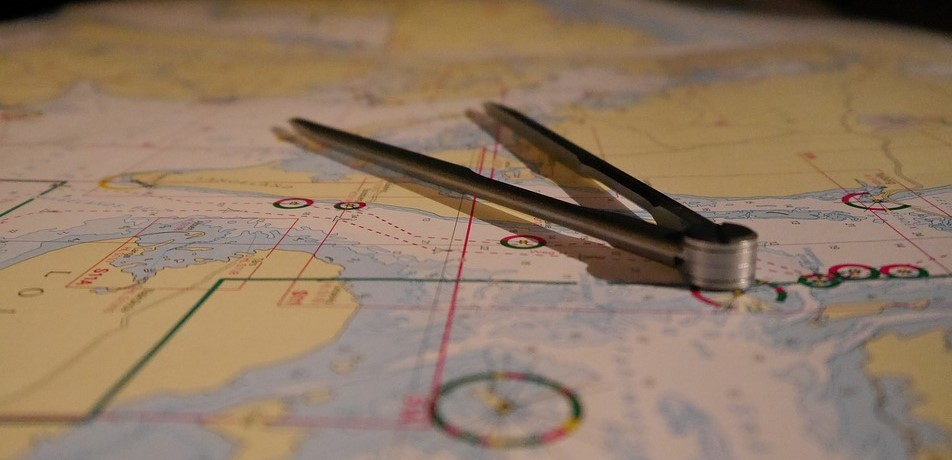

I talk to plenty of people struggling with the idea of planning in an agile environment. It seems hard to get the balance between not planning at all and planning on a level of detail that requires to take all sorts of assumptions concerning a relatively unknown future. A while ago, I did plan for a sailing trip, and it dawned on me that all too often, project plans are carved out as if we could predict the weather on a specific day years in advance.
We started planning for a 2-weeks sailing trip long before the actual cruise (aka project execution) – about a year in advance. We knew we’d take the boat on a certain date from Tromsø and would have to pass it on to the next crew two weeks later in Bodø, preferably in a good shape. These hand-over dates and places where actually not under our control. We knew we wanted to experience the midnight sun – that was part of our “vision” for the cruise.
Also, we had only limited control over the crew (aka. Team) – something experienced by many projects, too. A part of the crew had been sailing together before. But then there were more people signing up that we hadn’t even met before, because the boat bears space for more than our known crew. (Think self-assignment for the team.)
This reflected the first, high-level plan for our trip:
- Take on the boat in Tromsø on 11th July
- with a crew of seven people, two of them practically unknown to us. New hires, so to say.
- Hand-over the boat in Bodø on 25th July.
- Travels to and from the Boat organized individually; we would meet at the boat at the given time.
- Being responsible for the navigation during the trip, the next couple of months it was my job to take the planning to a next level. I needed to get an understanding of the situation in the area. I collected information from all possible sources, very similar to a PO trying to understand the market for his product.
| I cared about stuff like: | A PO would care about stuff like: |
|---|---|
|
|
Once Options got clearer, I needed to decide for a preferred route, including a rough sketch of the daily legs. It was a given we had to go south, not much options there. No matter if the weather was ideal for this direction. Important aspects for the selection where, amongst others:
- Which places did we really want to visit? E.g., we wanted to see the Trollfjord, we wanted to do Whale-Watching in Andenes, and some others.
- Which route fits the capabilities of the crew (team) and the boat (infrastructure)?
- Which route offers plenty of options on the way in case something unexpected happens?
- How frequently can we re-fill our tanks and stock-up on food?
- How can we split the whole trip into sensible legs for each day, allowing for some days on shore? (Shore-days are good for some sight-seeing while at the same time they add contingency to the plan).
I decided to opt for the route going down the inside of Vesterålen and Lofoten islands for reason of better shelter and less exposure to the open arctic sea, plus more options for infrastructure and alternative harbors and bays, based on the actual weather. On the downside, this meant a slight detour to get the Whale-watching dream to become reality, but we gladly traded this in for safety and comfort of both crew and boat.
This first plan is a bit like an initial Backlog. It leaves plenty of room to adapt on any situation once you know more about the actual reality you find yourself in.
In the days before getting on the boat, we started consulting the weather forecasts on a regular basis to figure how the weather would affect our route. Would it allow to follow our plan or force us to adapt? Now would have been the time to adapt and chose an alternative basic route in case needed, building on the knowledge acquired through the previous planning activities.
Once on the boat, it is good practice to prepare a “passage plan” for each leg, day by day. Taking into account the latest weather data, the crew’s and the boat’s current condition, currents, tides, and the overall plan and framing conditions (like: the boat needs to be in Bodø by 25th July), one plans the target position for this next leg, the supposed route to get there, and any alternatives available in case something unexpected happens. We can compare this to a Sprint-Planning, and indeed if we use the whole cruise as an analogy for a project, then the leg must represent the iteration.[1]
Out on the water, the cruise is like a series of standups all the way. Constantly you’re checking what course you can actually sail, what drift you really have, what true course this represents (which might be nowhere near your passage plan). You will watch the weather, wind, and sea state as it evolves, and continuously reassess whether you need to adapt your plan. You might hit an unexpected rock, something on the boat breaks, or an unexpected storm comes up, and the situation forces you to react. Out on the ocean, it seems much more natural that the number of things that can happen to you are beyond imagination, and you will need to be prepared at any moment to abandon your plan, because it obviously isn’t in line with reality anymore. For some reason, it seems to be much harder to acknowledge a similar situation in business endeavors. However, plenty of stuff can happen that impacts your market to the extent that your plan simply renders useless. It might be as simple as a competitor launching a new product to as fundamental as an economic bubble bursting.
In today’s world, your market, including your user’s requirements, might be similarly volatile than the weather on the ocean, and can turn just as quickly. Your market analysis will be by far less accurate than any sea chart published – and yet many expect we can plan for projects and define product requirements well ahead, while a sailboat touching ground from time to time comes as no big surprise.
The bottom line here is that when it comes to planning, we should be very mindful about our assumptions. There’s nothing wrong with a bit of up-front planning – quite in contrary. If you plan based on the stable or slowly-changing dimensions in your environment and leave enough room to navigate according to the more volatile aspects once you’re on the spot. This might feel like losing control, where in fact it’s only losing imaginary control. Let’s confront the brutal fact: none of us will control the weather – or a market, for that matter – anytime soon. Let’s rather set ourselves up so that we can deal with whatever reality has on stock for us.
My lesson from Sailing is this: Think of long-term plans as a tool that enables tactical short-term planning leading to an envisioned end. There’s no way we could have delivered our boat in-time to Bodø without much of the early planning efforts. And the reliability of any more detailed early plans would have been questionable at best.

[1] It is even a common practice on board to have a debriefing once the boat is moored, which is kind of a retrospective meeting.
 Marc's Thought Nuggets